• Sign Up! To view all forums and unlock additional cool features

    Welcome to the #1 Dodge, Jeep and RAM Forum dedicated to FCA owners and enthusiasts. Register for an account, it's free and it's easy, so don't hesitate to join the SRT Forum today!


DSC Suspension Controller - tuning and talk

rayzazoo

Active Member
Member ID
#1482
Messages
157
Reactions
496
Likes
67
City
Somewhere
State
Non-US
Country
United States
Vehicle
Hellcat
#21
What settings did you need to change?
Looks like a progressive front suspension rebound control.

1785579622591.png


OP
DGatzby

DGatzby

9000 Posts Club
Founding Member
Premium Account
U.S. Air Force Veteran
Donating Member
HFCOTM & HFCOTY
Member ID
#797
Messages
9,613
Reactions
56,613
Likes
402
City
SW Twin Cities
State
MN
Country
United States
Vehicle
2019 Dodge Challenger Redeye WB
Thread Starter #22
Great summary @rayzazoo. I really CAN feel the independent shock control just driving down the street. That is one of its big differences that I have enjoyed.

The one item that looks interesting is the comfort numbers, and the most easy to change. Less is softer as the default or at no input from driver. Sport rides more soft than street! I am going to drive it a bit today and see if I can feel the ride difference btw Street and Sport. I’ll start there.

Let’s hear more about the acceleration deal. Ray says 1500ms, I may just change it and see if I can perceive something there too. :p It can accelerate if I want it to.:rolleyes:


covidcommander

1000 Posts Club
Member ID
#7706
Messages
1,720
Reactions
2,492
Likes
162
City
Clementon
State
NJ
Country
United States
Vehicle
2018 Charger
#23


rayzazoo

Active Member
Member ID
#1482
Messages
157
Reactions
496
Likes
67
City
Somewhere
State
Non-US
Country
United States
Vehicle
Hellcat
#24
Great summary @rayzazoo. I really CAN feel the independent shock control just driving down the street. That is one of its big differences that I have enjoyed.

The one item that looks interesting is the comfort numbers, and the most easy to change. Less is softer as the default or at no input from driver. Sport rides more soft than street! I am going to drive it a bit today and see if I can feel the ride difference btw Street and Sport. I’ll start there.

Let’s hear more about the acceleration deal. Ray says 1500ms, I may just change it and see if I can perceive something there too. :p It can accelerate if I want it to.:rolleyes:
I think it'll be dependent on the setup. Once you hit 60mph or the threshold timer, the acceleration table is done.

So let's say est. 0-60mph - threshold timer = time not in accel table
Hellcat 3.7 s - 1.5 s = 2.2
Redeye 3.4 s - 1.5 s = 1.9
SS 3.25 s - 1.5 s = 1.75

Diablosport only spent 1 second in the accel table while DSC had 2 seconds. When Mike from DSC was made aware of the DS controller, the feedback was 1.5 seconds might be the sweet spot, but that was also for a 2015 Hellcat. Once the timer is done, it goes back to the GForce table and %.

Another thing to consider is actual 60ft times. If these are <2 seconds, then it helps explain why DiabloSport elected for only 1 second vs DSC 2 seconds.

I think a more accurate measurement is log personal 0-60 ft times. Then tweak the threshold timer.

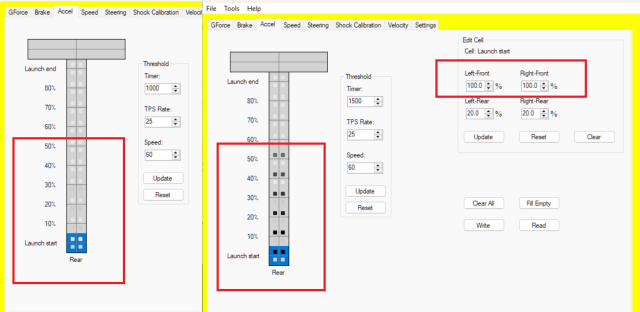
Next, tweak the acceleration table % on the desired amount of front and rear.

Interestingly, the 2018 Demon launch suspension strategy: "Bilstein adaptive dampers are set to firm up compression and rebound in the rear while softening front rebound, letting the front end rise freely as weight shifts entirely to the back wheels" Great for a wheelie.

Then the 2023 Demon 170 "raises the nose more slowly, putting more energy into forward acceleration instead of a dramatic wheelie." Slower front rise.

Between these observations and @catdad settings of 100 (firm) / 10 (soft), it could explain why it's a more planted feeling with little to no wheel spin.

Controlled front extension with maximum rear compliance—reducing wasted pitch and oscillation while maintaining rear-tire loading.

That is much closer to the Demon 170 philosophy than the factory DSC 10/20 soft-front/soft-rear launch map. @catdad phrase “a ton of pressure on the rear” is describing rear-tire loading, not firm rear damping.

Comparing the G-force table at 0.6 and Launch Start accel table:

OEM launch calibration
Front: 60% → 10%
Rear: 80% → 20%

Both ends become dramatically softer. The front can extend easily, and the rear can compress easily. This encourages weight-transfer motion, but it can also create more pitch, oscillation, or wheel hop.

User calibration
Front: 60% → 100%
Rear: 80% → 10%

This is a radically different strategy:

Front becomes much more controlled.
Rear becomes almost completely released.

It is best described as:

Firm front, very soft rear.

The acceleration itself still transfers load rearward. The stiff front controls how quickly the nose moves, while the soft rear lets the suspension absorb the torque application and load the rear tires.

For the 100/10, it could be more effective on an unprepared surface or street-oriented tire when the problem is immediate wheelspin.
The DSC 10/20 setting may work better when the surface is prepared and the tires can tolerate a more aggressive weight-transfer event.


Last edited:

Linda's Hell Cat

6000 Posts Club
Staff Team
Founding Member
Premium Account
Donating Member
9 Second Best E/T
Member ID
#972
Messages
6,579
Reactions
42,189
Likes
352
City
Bucks County
State
PA
Country
United States
Vehicle
2015 Charger Hellcat
#25
@rayzazoo it's Great To see you posting up! :):)

Thanks for your knowledgeable and useful information.:cool::cool::cool::cool:

~Linda :)


OP
DGatzby

DGatzby

9000 Posts Club
Founding Member
Premium Account
U.S. Air Force Veteran
Donating Member
HFCOTM & HFCOTY
Member ID
#797
Messages
9,613
Reactions
56,613
Likes
402
City
SW Twin Cities
State
MN
Country
United States
Vehicle
2019 Dodge Challenger Redeye WB
Thread Starter #26
^ nice.

I have some stuff to add for just using on the street. Cleaned it up and went down to spend $70 for this mysterious liquid so it can run for a few miles. Since Sport comfort is more soft initially than Street, first I needed to feel it.

I agree, it sure is fancy and very subtle, but it is softer!

So, without changing their program we may have something there. If Sport (suspension only) has a more aggressive response to our inputs than street AND rides initially more comfy, I’m in.

Okay, I did a read to make sure I was looking at the right numbers. With the exception of this comfort setting I do not see differences btw the three different settings, in these tables. I am no genius but just looking at the G-force table and the braking table, the numbers look identical between the three?


rayzazoo

Active Member
Member ID
#1482
Messages
157
Reactions
496
Likes
67
City
Somewhere
State
Non-US
Country
United States
Vehicle
Hellcat
#27
^ nice.

I have some stuff to add for just using on the street. Cleaned it up and went down to spend $70 for this mysterious liquid so it can run for a few miles. Since Sport comfort is more soft initially than Street, first I needed to feel it.

I agree, it sure is fancy and very subtle, but it is softer!

So, without changing their program we may have something there. If Sport (suspension only) has a more aggressive response to our inputs than street AND rides initially more comfy, I’m in.

Okay, I did a read to make sure I was looking at the right numbers. With the exception of this comfort setting I do not see differences btw the three different settings, in these tables. I am no genius but just looking at the G-force table and the braking table, the numbers look identical between the three?
All of the GForce and braking tables are the same.

Where they differ is the Settings of Chassis Tour, Sport, and Track and how the % on the GForce table references the Shock Calibration Table.

While in the G Comfort "box" of <0.25 g the % in the Default rate is applied to the Shock Calibration Table.

For example,
Tour Default Rate of 34% outputs approximately 400 mA (soft).
Sport Default Rate of 18% outputs approximately 400 mA (soft).
Track Default Rate of 28% outputs 200 mA (firmer).

The acceleration table Launch start.
When launch is activated, the threshold timer of 1-2 seconds applies.
10% front / 20% rear is 400 mA front (soft) / 400 mA rear (soft).
100% front / 10 % rear is 100 mA front (stiff) and 400 mA rear (soft).

Outside of the "box" >0.25 g and acceleration launch, the G Table applies.

Using 0.6 g and 0 left/right results in 60% / 60% front, and 80% / 80% rear.
Applied to the Shock Table
Tour is 200 mA front (softer) / 100 mA rear (firm).
Sport/Track is 100 mA front (firm) / 100 mA rear (firm).

The best part is that you can customize individualized Acceleration Launch Tables for each Chassis setting.

For non-drag racing, the way Mike explained the difference between OEM and DSC is independent references per corner and has a lot more table value references. This helps explain the smooth transition in turns which feels more controlled.

All great stuff and makes me want to go play with the Hellcat today.


Last edited:

catdad

Active Member
Founding Member
9 Second Best E/T
Member ID
#869
Messages
161
Reactions
223
Likes
37
City
Lake City
State
FL
Country
United States
Vehicle
2019 Charger Hellcat
#28
What settings did you need to change?
compression and rebound. also the time it stays in launch mode


OP
DGatzby

DGatzby

9000 Posts Club
Founding Member
Premium Account
U.S. Air Force Veteran
Donating Member
HFCOTM & HFCOTY
Member ID
#797
Messages
9,613
Reactions
56,613
Likes
402
City
SW Twin Cities
State
MN
Country
United States
Vehicle
2019 Dodge Challenger Redeye WB
Thread Starter #29
All of the GForce and braking tables are the same.

Where they differ is the Settings of Chassis Tour, Sport, and Track and how the % on the GForce table references the Shock Calibration Table.

While in the G Comfort "box" of <0.25 g the % in the Default rate is applied to the Shock Calibration Table.

For example,
Tour Default Rate of 34% outputs approximately 400 mA (soft).
Sport Default Rate of 18% outputs approximately 400 mA (soft).
Track Default Rate of 28% outputs 200 mA (firmer).

The acceleration table Launch start.
When launch is activated, the threshold timer of 1-2 seconds applies.
10% front / 20% rear is 400 mA front (soft) / 400 mA rear (soft).
100% front / 10 % rear is 100 mA front (stiff) and 400 mA rear (soft).

Outside of the "box" >0.25 g and acceleration launch, the G Table applies.

Using 0.6 g and 0 left/right results in 60% / 60% front, and 80% / 80% rear.
Applied to the Shock Table
Tour is 200 mA front (softer) / 100 mA rear (firm).
Sport/Track is 100 mA front (firm) / 100 mA rear (firm).

The best part is that you can customize individualized Acceleration Launch Tables for each Chassis setting.

For non-drag racing, the way Mike explained the difference between OEM and DSC is independent references per corner and has a lot more table value references. This helps explain the smooth transition in turns which feels more controlled.

All great stuff and makes me want to go play with the Hellcat today.
Okay. But where does it get the info to become more firm (ultimately or quicker) in Track VS Tour? Even though the OEM controller only worked the four in unison it was ultimately more stiff in Track. Right?

I will say whatever is programmed into Sport handles pretty darn well. Did a round-about and then even was able to hammer it leaving, and some other quick corners seem to feel different and to the better. I tried something that should have at least caused some tire noise- quiet. AND IT STICKS. Interesting.


rayzazoo

Active Member
Member ID
#1482
Messages
157
Reactions
496
Likes
67
City
Somewhere
State
Non-US
Country
United States
Vehicle
Hellcat
#30
Okay. But where does it get the info to become more firm (ultimately or quicker) in Track VS Tour? Even though the OEM controller only worked the four in unison it was ultimately more stiff in Track. Right?

I will say whatever is programmed into Sport handles pretty darn well. Did a round-about and then even was able to hammer it leaving, and some other quick corners seem to feel different and to the better. I tried something that should have at least caused some tire noise- quiet. AND IT STICKS. Interesting.
I really enjoy reading the "hammer it leaving, and some other quick corners seem to feel different and to the better"!
Similarly, I felt I could take corners at higher speed and things just felt planted. I believe this is due to DSC ability to give independent control to each damper.

The Tour, Sport and Track differences primarily come from the Shock Calibration table and G-Comfort settings and how quickly the suspension transitions from 400 mA (soft) to 100 mA (firm) vs gForce in each chassis setting.

This example demonstrates acceleration but in corning, each damper is independently operating on a similar, quicker transition as g Force increases.

Tour g = front / rear mA
<0.25 = 400 / 400 (GComfort)
0.25-0.4 = 200 / 200
0.40 g = 200 / 200
0.60 g = 200 / 100
0.80 g = 100 / 100
1.00 g = 100 / 100

Sport g = front / rear mA
<0.25 = 400 / 400 (GComfort)
0.25-0.4 = 200 / 200
0.40 = 200 / 100
0.60 = 100 / 100
0.80 = 100 / 100
1.00 = 100 / 100

Track g = front / rear mA
<0.25 g = 200 / 200 (GComfort)
0.25-0.4 = 200 / 200
0.40 = 200 / 100
0.60 = 100 / 100
0.80 = 100 / 100
1.00 = 100 / 100

The area that I'm tweaking today is the Acceleration Tables for Tour, Sport and Track Chassis. This table is predictive vs. GForce reactive and something I haven't really tweaked. The revisions focus on how the suspension behaves during the first 1–2 seconds of a driver input, before the dynamic control algorithms fully assume control.

Aside from the Launch suspension tweak, I'm focused on a road course suspension setup so we get more of the smooth, controlled cornering we felt from the gForce table (reactive) to the acceleration table (predictive). I always felt coming out of a low speed, low g Force corner that the hellcat was uncontrolled acceleration (perhaps a 400 mA to 100 mA transition) rather than a more controlled acceleration (200 mA to 100 mA).

The acceleration table (10%-80%) starts at 400 mA (predictive) so getting that started at 200 mA (predictive) for Sport/Track chassis setup. Next is tweaking the threshold, TPS and mph settings. We already have a good range of 1000-2000ms for threshold but a higher MPH might keep the suspension out of the 400 mA (predictive) on acceleration and in 200 mA (predictive).


Last edited:

Unholy707

8000 Posts Club
9 Second Best E/T
HFCOTM
Member ID
#11903
Messages
8,872
Reactions
7,781
Likes
402
City
Orlando
State
FL
Country
United States
Vehicle
2015 Dodge Challenger Hellcat
#31
I'd really like to figure out how the 170 is calibrated


Unholy707

8000 Posts Club
9 Second Best E/T
HFCOTM
Member ID
#11903
Messages
8,872
Reactions
7,781
Likes
402
City
Orlando
State
FL
Country
United States
Vehicle
2015 Dodge Challenger Hellcat
#32
I would like to see what the "stock settings" for this would be for hellcat and demon 170, I wonder if they can figure that out


vortecd

Poster Club Hall of Fame
Premium Account
Donating Member
9 Second Best E/T
HFCOTM
Member ID
#1248
Messages
63,305
Reactions
221,007
Likes
402
City
Middleville
State
MI
Country
United States
Vehicle
2016 Charger Hellcat
#33
I'd really like to figure out how the 170 is calibrated
You have a 15 and me a 16 but if we had an 18 or newer I believe @Jon-MooredPerformanceLLC was able to add some drag mode that changed the shock settings


Unholy707

8000 Posts Club
9 Second Best E/T
HFCOTM
Member ID
#11903
Messages
8,872
Reactions
7,781
Likes
402
City
Orlando
State
FL
Country
United States
Vehicle
2015 Dodge Challenger Hellcat
#34
Yeah, I'm curious if the DSC could mimmic the 170 suspension settings or if they're going about it completely differently


Unholy707

8000 Posts Club
9 Second Best E/T
HFCOTM
Member ID
#11903
Messages
8,872
Reactions
7,781
Likes
402
City
Orlando
State
FL
Country
United States
Vehicle
2015 Dodge Challenger Hellcat
#35
Do you tune these at all @zhc or have an opinion on them?


rayzazoo

Active Member
Member ID
#1482
Messages
157
Reactions
496
Likes
67
City
Somewhere
State
Non-US
Country
United States
Vehicle
Hellcat
#36
After messing around with the acceleration tables and testing, DSC is probably one of the most underrated Hellcat driveability mods.

I tweaked the acceleration table to firm up the front and soften the rear dampers during 0-60mph acceleration. This created a "wedge anchor" that reduced front nose lift, and controlled weight transfer to the rear for the threshold timer value. The other benefit is applying this throughout the acceleration table so you could apply it throughout regular driving. Then you can customize Normal, Sport, and Track to have their own independent settings. Independent testing will determine what acceleration threshold timer works best for you. After trying 2000, 1500, 1300 and 1000, I found 1225ms worked well for a 2015 Hellcat with stock suspension and Michilen PS4S tires. This also considered steering feel. I found the greater the threshold timer, the stiffer the steering felt. Too little resulted in oversteer. Too much resulted in understeer.

If drag strip racing, you could go the same route as @catdad with firm front and soft rear and threshold timer for a prepped drag strip and drag tires. Finding the right threshold timer that works best for straight line will be a mix of how well you hook on your tire setup. Test, test, test.

If track racing, it was surprising that all modes had a soft damper setting 0-60mph during acceleration at all 4 corners. @DGatzby, I think this is where there can be a real benefit in Track Mode. Instead of leaving the Accel table at the full 400 mA front / 400 mA rear range, you can tune it closer to 200 mA front / 100 mA rear. This reduces the amount of chassis movement under initial throttle and creates a smoother transition into the G-Force table, where much of the Sport/Track calibration is already operating around 200/200 or 200/100 mA. For the track acceleration table of 10-80%, I put 50 LF-RF, and 20 LR-RR.

One test where this really stood out was a 90-degree corner: approximately 55 mph approaching the braking zone, slowing to about 25 mph at the apex, then accelerating through the exit to 70+ mph. As throttle came back in, the car stayed composed and held its line through the apex and exit rather than developing the noticeable front-end rise and chassis movement felt with a 4,400-lb Hellcat out of a corner.

The result wasn't simply a “stiffer” suspension. The car transitioned from braking → cornering → acceleration as one controlled movement, which gave much more confidence getting back into the throttle on corner exit.

To @Unholy707, you could customize the entire damper configuration to maximize straight-line performance rather than relying solely on the OEM suspension/damper settings or Launch Control. Demon 170 uses different suspension parts so that is something to consider too, but the ability to custom configure the dampers is a good thing.


Last edited:

Unholy707

8000 Posts Club
9 Second Best E/T
HFCOTM
Member ID
#11903
Messages
8,872
Reactions
7,781
Likes
402
City
Orlando
State
FL
Country
United States
Vehicle
2015 Dodge Challenger Hellcat
#37
After messing around with the acceleration tables and testing, DSC is probably one of the most underrated Hellcat driveability mods.

I tweaked the acceleration table to firm up the front and soften the rear dampers during 0-60mph acceleration. This created a "wedge anchor" that reduced front nose lift, and controlled weight transfer to the rear for the threshold timer value. The other benefit is applying this throughout the acceleration table so you could apply it throughout regular driving. Then you can customize Normal, Sport, and Track to have their own independent settings. Independent testing will determine what acceleration threshold timer works best for you. After trying 2000, 1500, 1300 and 1000, I found 1225ms worked well for a 2015 Hellcat with stock suspension and Michilen PS4S tires. This also considered steering feel. I found the greater the threshold timer, the stiffer the steering felt. Too little resulted in oversteer. Too much resulted in understeer.

If drag strip racing, you could go the same route as @catdad with firm front and soft rear and threshold timer for a prepped drag strip and drag tires. Finding the right threshold timer that works best for straight line will be a mix of how well you hook on your tire setup. Test, test, test.

If track racing, it was surprising that all modes had a soft damper setting 0-60mph during acceleration at all 4 corners. @DGatzby, I think this is where there can be a real benefit in Track Mode. Instead of leaving the Accel table at the full 400 mA front / 400 mA rear range, you can tune it closer to 200 mA front / 100 mA rear. This reduces the amount of chassis movement under initial throttle and creates a smoother transition into the G-Force table, where much of the Sport/Track calibration is already operating around 200/200 or 200/100 mA. For the track acceleration table of 10-80%, I put 50 LF-RF, and 20 LR-RR.

One test where this really stood out was a 90-degree corner: approximately 55 mph approaching the braking zone, slowing to about 25 mph at the apex, then accelerating through the exit to 70+ mph. As throttle came back in, the car stayed composed and held its line through the apex and exit rather than developing the noticeable front-end rise and chassis movement felt with a 4,400-lb Hellcat out of a corner.

The result wasn't simply a “stiffer” suspension. The car transitioned from braking → cornering → acceleration as one controlled movement, which gave much more confidence getting back into the throttle on corner exit.

To @Unholy707, you could customize the entire damper configuration to maximize straight-line performance rather than relying solely on the OEM suspension/damper settings or Launch Control. Demon 170 uses different suspension parts so that is something to consider too, but the ability to custom configure the dampers is a good thing.
Thanks @rayzazoo , while some components are different, the magic comes from their suspension settings for the shocks in drag mode I believe. It would be nice to see a dump from a dampener module from a 170, I assume DSC would have had to do this with a regular hellcat in order to develop their software


rayzazoo

Active Member
Member ID
#1482
Messages
157
Reactions
496
Likes
67
City
Somewhere
State
Non-US
Country
United States
Vehicle
Hellcat
#38
Thanks @rayzazoo , while some components are different, the magic comes from their suspension settings for the shocks in drag mode I believe. It would be nice to see a dump from a dampener module from a 170, I assume DSC would have had to do this with a regular hellcat in order to develop their software
Everything describe in the launch of a Demon 170 is letting the front rise while controlling the rear.
Almost like anti-squat. Rear of the Demon 170 also sits higher.

You could recreate the Demon 170 strategy in DSC during launch and acceleration:
softer front damping to allow front rise, firmer rear damping to control rear compression.
Limitations would be the remaining hardware.

Alternatively, @catdad did firm front and soft rear. That seems to use the OEM springs and a more controlled front end as a leverage point, while allowing the rear suspension to compress and accept the weight transfer. This strategy might work better with the suspension hardware already on the Charger Hellcat.

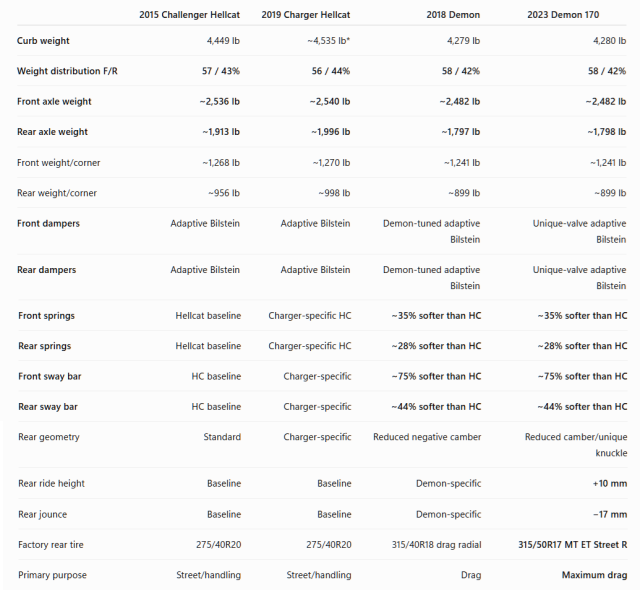
Comparatively, I tested a softer front setting for Challenger Hellcat. Calculated, the Charger has approximately 80 lb more static load over the rear axle than the 2015 Challenger and a roughly 4-inch longer wheelbase.

I'm not sure the same strategy would be optimal with a soft-sidewall drag radial but seems to be working for @catdad.
A drag radial may benefit more from allowing front extension while controlling the rear, closer to the Demon 170 strategy.
That's something that would need to be tested.

With a little help from AI, I think we collect the hardware variables and use all of the geeky math to see what DSC configurations could work.
I think the table below is noteworthy for rear axle weight comparisons.


1786289663556.png


Last edited:
OP
DGatzby

DGatzby

9000 Posts Club
Founding Member
Premium Account
U.S. Air Force Veteran
Donating Member
HFCOTM & HFCOTY
Member ID
#797
Messages
9,613
Reactions
56,613
Likes
402
City
SW Twin Cities
State
MN
Country
United States
Vehicle
2019 Dodge Challenger Redeye WB
Thread Starter #39
Thanks Ray! I got done with my part of a major home project Friday. That is going to allow me to get into this now. I am fired up because my car really feels good! We took a 500mi round trip with the Durango. I want the Durango controller also, it rides like a truck with sharp rebounds and feels bad now. Wow.

I know at this point anyway several things..
- it is not the DS unit at all and seems to have almost enhanced different and fundamental control.
- whatever the settings are in Sport Mode from the neutral ride to how it then behaves, I am going to like to make those settings my street (default).
- I have done a couple of these 90 degree bends also. Besides the perception you describe about firming up the sway dramatically, I have a 90 with a downward hill also. It makes that turn fairly aggressively (fast), and besides this more stable feeling the tires are silent!

@rayzazoo I need to understand a lot more around which screens (settings) and how we are entering the numbers. In the short time I viewed the “tune” downloaded from the car, I don’t see anything but blank entries, except for the first screen that has the % shock values and the acceleration screen. I have until Oct 17 before putting it on the track at RA, to play with the Track settings, and then want to understand the system so depending on how she works I can make some changes on the fly.

Can I ask for some help to better understand where, how and what is going on with the mA settings? Where are the fundamental rebound settings, or as we increase these is all that taken care of either to a lessor or greater degree? Let me know if you can help. I am also going to watch all of their tutorial library today. Hope to be smarter soon.


OP
DGatzby

DGatzby

9000 Posts Club
Founding Member
Premium Account
U.S. Air Force Veteran
Donating Member
HFCOTM & HFCOTY
Member ID
#797
Messages
9,613
Reactions
56,613
Likes
402
City
SW Twin Cities
State
MN
Country
United States
Vehicle
2019 Dodge Challenger Redeye WB
Thread Starter #40
Without the actual values, everything describe in the launch of a Demon 170 is letting the front rise while controlling the rear. Almost like anti-squat. Rear of the Demon 170 also sits higher.

You could recreate the Demon 170 strategy in DSC during launch and acceleration:
softer front damping to allow front rise, with firmer rear damping to control rear compression.
Limitations would be the remaining hardware.

Alternatively, @catdad went the opposite direction — firm front and soft rear. That seems to use the OEM springs and a more controlled front end as a leverage point, while allowing the rear suspension to compress and accept the weight transfer. This strategy might work better with the suspension hardware already on the Charger Hellcat.

Comparatively, I tested a softer front setting for Challenger Hellcat. Calculated, the Charger has approximately 80 lb more static load over the rear axle than the 2015 Challenger and a roughly 4-inch longer wheelbase. This approach produced noticeably more controlled 0–60 mph acceleration on street tires, with less excessive front-end rise.

Compared to the Demon 170 it's ~ 54 lb apart. Yet, Dodge made the Demon 170 front springs approximately 35% softer, rear springs approximately 28% softer, and dramatically softened the stabilizer bars.

I'm not sure the same strategy would be optimal with a soft-sidewall drag radial but seems to be working for @catdad.
A drag radial may benefit more from allowing front extension while controlling the rear, closer to the Demon 170 strategy.
That's something that would need to be tested.

With a little help from AI, I think we collect the hardware variables and use all of the geeky math to see what DSC configurations could work.


View attachment 185479
Good idea. I wonder if Shortshift’s Bot would get into this? It has Dodge flat hammered and seems to really know its shit. Okay…. off to watch some videos carefully for starters.


Top